How to Order at Japan's Beef Bowl Chains: Matsuya's Ticket Machines and the Sukiya & Yoshinoya Touch Panels
Published: 2026-10-10
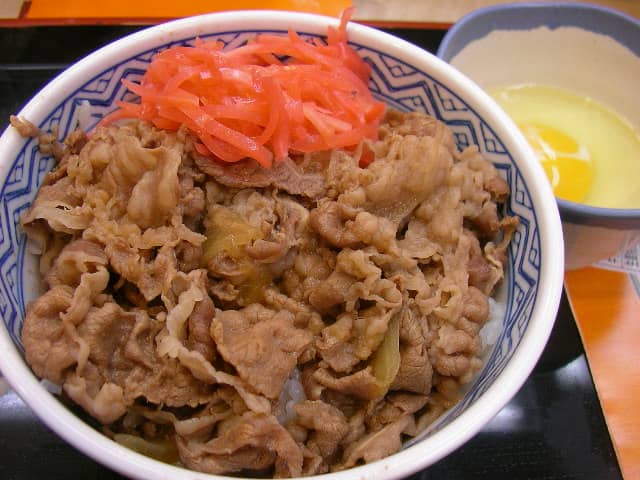
Yoshinoya, Matsuya and Sukiya are fast, affordable and easy to visit on your own — but each orders differently, from ticket machines to touch panels. Here's how ordering works at each chain, how to read the sizes, and answers to the questions visitors ask most.
The short answer
| Chain | Ordering and paying | Good to know |
|---|---|---|
| Matsuya | Order and pay first at the ticket machine by the entrance | Free miso soup when you eat in |
| Sukiya | Order on the touch panel at your seat; pay at the register afterwards | Staff bring the food to your seat |
| Yoshinoya | More and more branches use a touch panel at your seat; pay at the register afterwards | At self-service branches, you pick up your food and return your tray |
Ticket machines and touch panels switch to English, Chinese and Korean. Pick your language on the first screen.
Ordering can differ between branches of the same chain. The signs and posters at the entrance tell you which system it uses.
What is a beef bowl chain?
- Fast, affordable chains centered on gyudon: thinly sliced beef and onions simmered in a sweet-savory sauce over rice.
- They also serve curry, set meals and breakfast sets.
- Most seats are at counters and eating alone is completely normal. Many branches open late at night and early in the morning — a lifesaver on a trip.
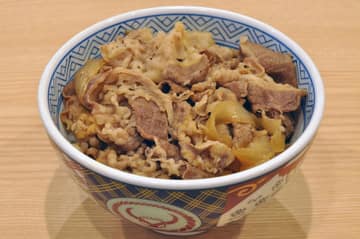 Gyudon (regular)Beef and onions simmered in a sweet soy sauce over rice — the classic "fast, cheap and tasty" Japanese meal.
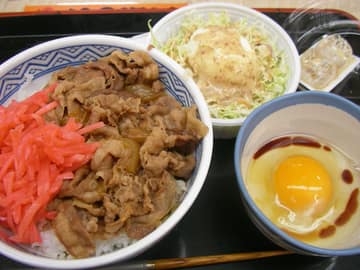 Make it a setAdd a raw egg, salad or miso soup to build your own set.
Matsuya: buy at the ticket machine first
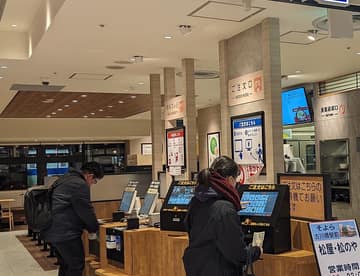 Matsuya's ticket machines and self-checkoutTouch-panel ticket machines at the entrance, where you order and pay before you sit. → Official site (Japanese)
- At the ticket machine by the entrance, tap the language button for English or another language.
- Choose your dish and size (mini, regular, large and so on).
- Pay. Besides cash, many branches take IC cards like Suica, credit cards and QR payments (it depends on the branch and the machine).
- Hand your ticket or receipt to the staff at your seat, or go to the pickup counter — some branches show your number on a screen when your food is ready.
- At self-service branches, take your dishes to the return counter when you finish.
At Matsuya, miso soup is free when you eat in (not with takeout).
Sukiya: order on the touch panel at your seat
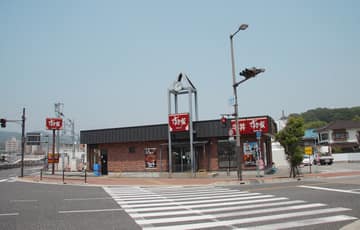 SukiyaKnown for its many gyudon toppings — cheese, green onion and egg, grated radish with ponzu and more. → Official site
- Take any free seat.
- On the touch panel at your seat, choose your language, then your dish, size and toppings, and send the order.
- Staff bring the food to your seat.
- When you finish, pay at the register. Many branches use "semi-self registers," where staff ring you up and you pay at the machine.
Yoshinoya: touch panels in some branches, ordering by voice in others
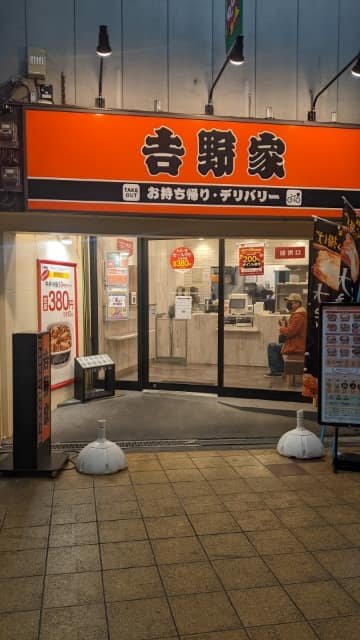 YoshinoyaThe original beef bowl chain, founded in 1899 in Nihonbashi, Tokyo. Look for the orange sign. → Official site
- Touch-panel branches: order on the panel at your seat. At self-service branches, the panel tells you when your food is ready and you pick it up at the counter. Return your tray when you finish, then pay at the register.
- Order-by-voice branches: staff come to take your order. Saying "Gyudon, nami" (regular gyudon) is enough. Pay at the register when you finish.
Reading the menu: sizes and handy words
| Word | Pronunciation | Meaning |
|---|---|---|
| 並盛 | nami-mori | Regular size — if in doubt, get this |
| ミニ・小盛 | mini / ko-mori | Smaller |
| 大盛 | oo-mori | More rice and more meat |
| 特盛 | toku-mori | Even more |
| 超特盛・メガ | cho-toku-mori / mega | The biggest size (the name varies by chain) |
| アタマの大盛・あたま大盛・中盛 | atama no oomori / chu-mori | Regular rice, extra meat |
| つゆだく | tsuyu-daku | Extra sauce |
| お持ち帰り | omochikaeri | Takeout |
- Add a raw egg, soft-boiled egg, miso soup or salad to make a set.
- There are also set meals (rice, miso soup and a main dish) and curry.
Free condiments on the table
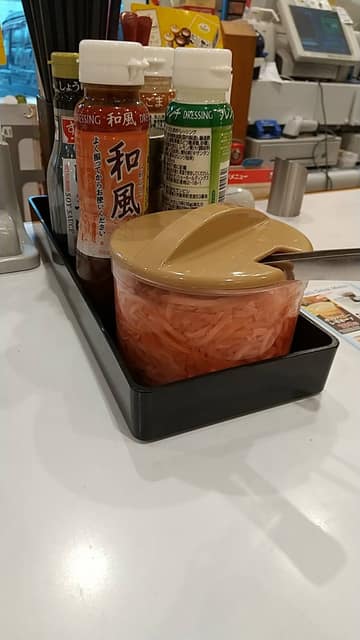 Beni shogaRed ginger pickled in sweet vinegar. A little on top cuts the richness. It's on the table — help yourself.
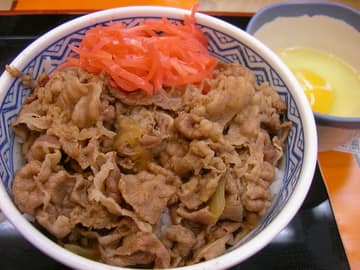 Shichimi and raw egg"Shichimi," a spicy seven-spice blend, is a classic. Many people pour a raw egg over their bowl for a milder taste.
- At some branches, water and tea are self-service.
Great for breakfast, too
- From early morning until late morning you can get a breakfast set (rice, miso soup, grilled fish, natto, egg and more) — handy if your hotel doesn't serve breakfast.
Good to know
- No tipping.
- People usually leave soon after eating. Counter seats are perfect for solo diners.
- Many ramen shops and standing soba bars use the same kind of ticket machine, so once you've learned it, it'll help you everywhere.
- Few dishes are meat-free, and sauces or broths may contain meat or fish. Vegetarians should take care. Allergen information is on each chain's official site.
Payment options vary by branch and machine. Keep a little cash in case cards or IC cards aren't accepted.
Frequently asked questions
Can I order if I don't speak Japanese?
Yes. Ticket machines and touch panels switch to English, Chinese and Korean, with photos of every dish.
Which size should I get the first time?
"Nami-mori" is the regular size. For more meat with the same amount of rice, choose "Atama no Oomori" (Yoshinoya), "Atama Oomori" (Matsuya) or "Chu-mori" (Sukiya).
Can I pay without cash?
Many branches take IC cards and credit cards, but it varies, so carry a little cash just in case.
Is it OK to go alone?
Absolutely. Most seats are at counters and many customers eat alone.
How late are they open?
Many branches open late at night and early in the morning, but hours vary. Check the store finder on the official sites.
Official websites
Menus, ordering systems and payment options can change. Check the official sites for the latest.
Read next
 Tokyo Street Food Guide: Tsukiji, Ameyoko, Asakusa, Yanaka and MoreGrazing your way through little stalls and shops, a bite here and a bite there, is one of the joys of Tokyo. Here are the best food streets, plus the etiquette to know.2026-10-06
 Tokyo's Rivers: The Sumida, Tama, Arakawa and More, With the Best Riverside SpotsSince the days of Edo, Tokyo has been a city of water. Rivers still run through it, lined with cherry trees, fireworks and water buses. Here are Tokyo's main rivers and how to enjoy them.2026-10-10
 Cosplay in Japan: Where to See It and Try It in Tokyo, the Biggest Events and the Etiquette to KnowCosplay, dressing up as characters from anime and games, is one of Japan's best-known cultural exports. Here's where to see it in Tokyo, studios where visitors can try it, Japan's biggest events, and the etiquette that really matters.2026-10-09