Japan Power Plugs and Voltage: Do You Need an Adapter? A Country-by-Country Guide (US, Taiwan, Spain, Sweden and More)
Published: 2026-10-13
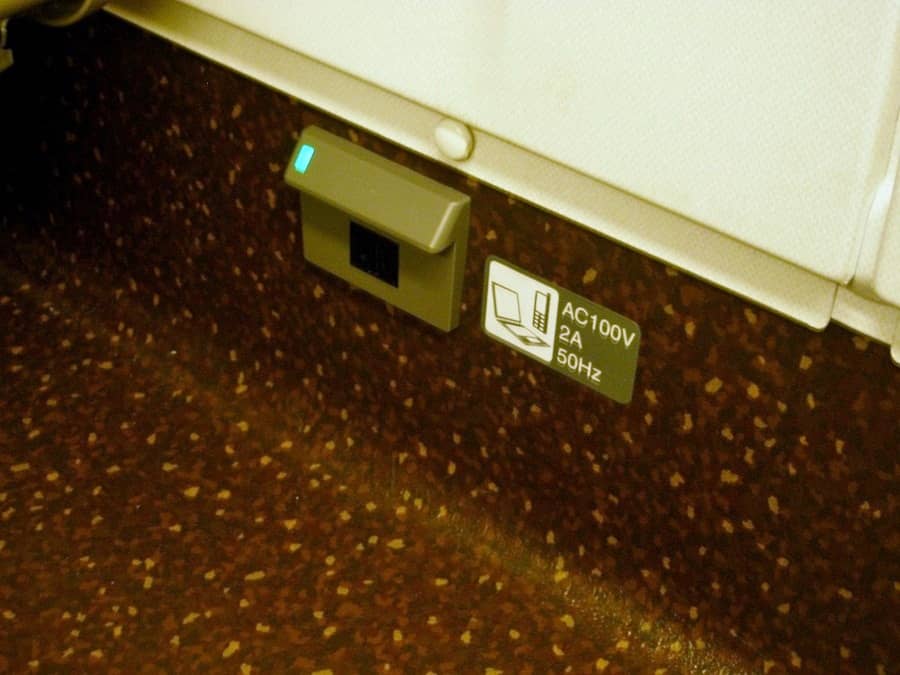
Japan uses Type A outlets at 100 volts. Will your plug fit? What about your hair dryer? Here's a country-by-country chart and answers to every charging headache.
The short answer
| Electricity in Japan | |
|---|---|
| Outlet type | Type A (two flat pins) |
| Voltage | 100V (one of the lowest in the world) |
| Frequency | 50Hz in eastern Japan, including Tokyo; 60Hz in western Japan, including Osaka |
| Phones and laptops | If the charger says "100-240V", it works as long as the plug fits |
| Hair dryers and straighteners | Non-travel models often won't work or run weak. Use the hotel's |
Not sure? Check the "INPUT" on your charger's label. If it says "100-240V", the voltage is fine and only the plug shape matters.
Country-by-country chart
| Country or region | Plug type | Voltage | In Japan? |
|---|---|---|---|
| USA and Canada | A / B | 120V | Two-pin plugs mostly work as is. Three-pin plugs, or plugs with one wider blade, may need an adapter |
| Taiwan | A / B | 110V | Two-pin plugs mostly work as is. Three-pin plugs need an adapter |
| Mexico | A / B | 127V | Two-pin plugs mostly work as is |
| Spain and Sweden | C / F | 230V | You need an adapter. Watch the voltage too |
| Most of Europe (Germany, France, Italy…) | C / F and others | 230V | You need an adapter |
| UK, Hong Kong and Singapore | G | 230-240V | You need an adapter |
| Australia and New Zealand | I | 230V | You need an adapter |
| South Korea | C / F | 220V | You need an adapter |
Some countries use other types in certain regions or buildings.
What to know about Japanese outlets
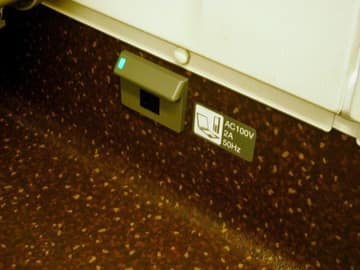 "100V, 50Hz" on the labelA seat outlet on the Shinkansen. Japanese outlets have these two flat slots.
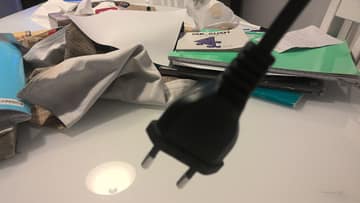 European round pins (Type C)Round pins from Spain, Sweden and elsewhere don't fit Japanese outlets.
- Three-pin outlets are rare: almost all Japanese outlets have two slots. Plugs with a third grounding pin (common on laptop power cords) need a three-to-two-pin adapter.
- Wide blades may not fit: US "polarized" plugs, with one blade slightly wider, may not go into older Japanese outlets.
- Outlets can be scarce: older hotels may have few outlets by the bed. A charger with several USB ports or a travel power strip helps.
Coming from Spain, Sweden or other 230V countries
Japan's 100V is less than half of Europe's 230V.
- Phone, laptop and camera chargers: almost all are "100-240V", so an adapter is all you need.
- Hair dryers, straighteners and shavers: 230V-only models may not heat up or not run at all. Most Japanese hotels have hair dryers, so the simplest move is to leave yours at home.
- Voltage converters are heavy and expensive. For a short trip, a "100-240V" travel dryer is easier than buying a converter.
Coming from the US, Taiwan or other 110-120V countries
The voltage is close, so most devices work as is. Heat-producing devices such as dryers may feel a little weaker.
If your polarized two-pin plug won't fit, pick up a small adapter at an electronics store or Don Quijote.
Buying electronics in Japan
Rice cookers, hair dryers and beauty gadgets sold at Japanese electronics stores are mostly for domestic use only (100V).
- To use them at home, choose products marked "100-240V" or "for overseas use" on the box or label.
- Some big electronics stores have a section for overseas models. Tell the staff you want to use it abroad and they'll help.
- Buying tax-free? Also read "Japan's new tax-free system from November 2026".
Where to buy an adapter
- Before you leave: buying one at home is the surest option.
- At the airport: shops at Narita and Haneda sell them.
- Electronics stores: Bic Camera, Yodobashi Camera and others have the widest range.
- Don Quijote and some convenience stores: open late and handy (stock varies).
- Hotel front desk: some hotels lend adapters. Ask at check-in.
Charging on the go
- Shinkansen: many trains have outlets at the seats.
- Power bank rental: services such as "ChargeSPOT" let you rent a power bank at a convenience store or station and return it elsewhere. You register in the app.
- Cafés: some have seats with outlets. Ask staff before plugging in.
- Convenience stores: sell charging cables and power banks.
Since July 2025, Japan's domestic flights require you to keep power banks with you, not in the overhead bin. On international flights, follow your airline's rules.
Airalo eSIM for Japan
As important as staying charged: getting online the moment you land. Buy and set it up in the app.
Frequently asked questions
What type of outlet does Japan use?
Type A, with two flat pins. It's the same shape as the two-pin plugs used in the US, Canada and Taiwan.
What is the voltage in Japan?
100V. The frequency is 50Hz in eastern Japan, including Tokyo, and 60Hz in western Japan, including Osaka.
Do I need a plug adapter for Japan from Spain or Sweden?
Yes. The round pins used in Spain and Sweden (Type C/F) don't fit Japanese outlets. Bring a Type A adapter.
Do I need a plug adapter for Japan from the US?
Two-pin plugs usually work as is. Three-pin plugs, or plugs with one wider blade, may need an adapter.
Do Taiwanese plugs work in Japan?
Taiwan's two-pin plugs are almost the same as Japan's, so they usually work as is. Three-pin plugs need an adapter.
Can I charge my phone without a voltage converter?
If the charger's label says "100-240V", you don't need a converter. If the plug shape doesn't fit, you only need an adapter.
Should I bring my hair dryer?
A 230V-only dryer may not heat up in Japan. Most Japanese hotels provide one, so it's best to leave yours at home.
Official websites
Hours, prices and rules can change. Check the official websites for the latest before you go.
Read next
 18 Everyday Things in Japan That Amaze the World: Trains, Safety, Omotenashi, Toilets and Where to Experience ThemTrains that run to the second, lost wallets that come back, free water and hot towels the moment you sit down. What's normal in Japan often leaves visitors speechless. Here are the everyday things that surprise the world, why they happen, and where to experience them in Tokyo.2026-10-10
 How to Use a Japanese Convenience Store: Checkout Phrases, Payment, Heating, Coffee and ATMsJapanese convenience stores (konbini) have food, coffee, ATMs, copiers and even parcel services — a traveler's best friend. But being asked "Atatamemasu ka?" or figuring out the coffee machine can be confusing at first. Here's everything from checkout phrases and payment to using the ATM.2026-10-08
 Tax-Free Shopping in Japan: The New Refund System from November 2026 and Where to ShopVisitors to Japan can shop without paying consumption tax at tax-free stores. But from November 1, 2026, the system changed: you now pay tax at the store and get it refunded when you leave Japan. Here's how the new process works, what to watch out for, and where tax-free shopping is easiest.2026-10-08